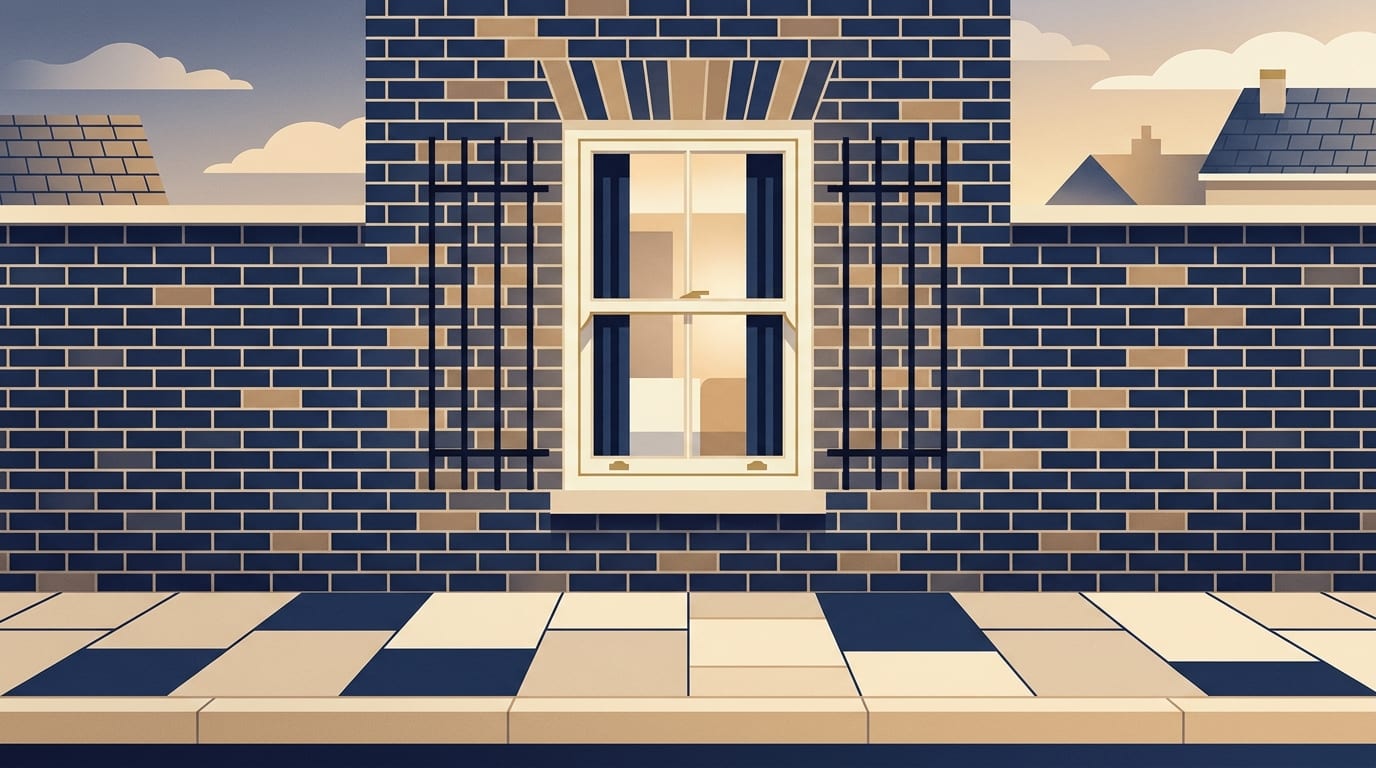
Homeowners, tenants and landlords often look at window bars, security grilles and heavy duty shutters to protect ground floor rooms. You might be worried about a break-in at night, or you might want a physical barrier across your glass while the house is empty. There is no single rule that bans window bars in the UK.
The problem is not whether you can buy them, but whether fitting them blocks your way out in a fire. Building regulations set out strict rules for fire safety and emergency escape routes in residential properties. The guidance for this is called Approved Document B. It is statutory guidance on fire safety under the building regulations for England only.
Wales, Scotland and Northern Ireland have their own guidance and their own rules. The building rules described in this guide apply in England unless stated otherwise. Approved Document B does not actually mention window bars or security grilles by name.
Instead, the guidance deals with escape windows. It says that certain rooms must have a window or door that people can use to get out if a fire blocks their normal route to the front door. A fixed bar or a locked grille across one of these windows could stop it working as an escape window. Whether a fixed bar is allowed on a specific window would be a matter for your local building control department to confirm before you begin any work. This is general information, not legal advice.
What an escape window is and why it matters
An emergency escape window or door is one that lets people reach a place free from danger from fire. This is a core part of the statutory guidance in Approved Document B Volume 1, which covers dwellings. The current version of this document is the 2019 edition incorporating later amendments, and the government page hosting it was last updated on 16 September 2026.
The guidance says people escaping should be able to reach a place free from danger from fire. Courtyards or inaccessible back gardens must meet its Diagram 2.5.
The guidance says an escape window should:
- Let people reach a place free from danger from fire.
- Be capable of remaining open without being held.
- Be capable of having locks fitted, with or without removable keys, which the guidance allows.
- Be capable of having opening stays with child-resistant release catches, which it also allows.
If you want to know how window restrictors keep children safe, the guidance says opening stays with child-resistant release catches may be fitted to escape windows.
The size rules for escape windows in England
Approved Document B Volume 1 says windows or external doors providing emergency escape should have an unobstructed openable area of at least 0.33m2.
The window should also have a minimum height of 450mm and a minimum width of 450mm. The route through the window may be at an angle rather than straight through.
The bottom of the openable area should be a maximum of 1100mm above the floor.
The table below shows the size rules for an emergency escape window in England.
|
Escape window size rules in England |
Measurement |
|---|---|
|
Minimum openable area |
0.33m2 |
|
Minimum height and width |
450mm |
|
Maximum height of the bottom of the openable area above the floor |
1100mm |
These figures come from Approved Document B Volume 1, which is statutory guidance for England. Wales, Scotland and Northern Ireland have their own guidance.
If you are replacing an existing window, the guidance says that when an existing window that would be an escape window in a new dwellinghouse is replaced, the replacement should be sized to provide at least the same potential for escape. If the old window was much larger than needed, you do not have to keep it that big. It can be reduced in size, but only down to the minimum measurements required for escape.
Which windows need to be escape windows
Not every single window in a house needs to be an escape window. The guidance depends on which storey the room is on and what the room is used for. It deals with habitable rooms, excluding kitchens.
On the ground storey of a house, all habitable rooms should have a safe way out. Excluding kitchens, every habitable ground floor room should have either an opening directly onto a hall leading to a final exit, or an emergency escape window or door. If a ground floor living room does not open into a safe hallway, its window must meet the escape size rules. A fixed bar across that window would be a matter for building control to confirm.
For upper storeys, the guidance covers floors up to a maximum of 4.5m above ground level that are served by only one stair. All habitable rooms on these floors, excluding kitchens, should have either an emergency escape window or external door, or direct access to a protected stairway. Two rooms may be served by a single escape window, but only if a door between them gives access to it.
If you live in a flat, Approved Document B Volume 1 gives the same escape window rules for flats in Section 3. This means the minimum openable area of 0.33m2, the minimum height and width of 450mm, and the maximum 1100mm to the bottom of the openable area all apply to flats as well.
There are also specific rules for a flat that is ancillary to the main use of a building,, and it has its own conditions. The document lists conditions for these, including that any security measures in any parts of the building do not prevent escape at all material times.
What fire and rescue services say about gates and shutters
The advice from the London Fire Brigade on escape plans covers additional security gates and shutters.
If you have additional security gates or shutters, make sure they can be easily opened from the inside without a key in a fire. If you fit a grille or shutter on a window, ask for one that opens easily from the inside without a key.
The London Fire Brigade also advises that you must keep door and window keys where everyone you live with can find them. Fire Kills adds that everyone in the household should know where the keys are.
If you hire a tradesperson to fit a grille or shutter, ask how it opens from the inside and ask for a release that works without a key. Speak to building control and a qualified fitter before any work starts.
Locks, keys and quick ways out
The government's Fire Kills campaign gives advice on keys and escape routes.
The Fire Kills campaign advises keeping door and window keys in a safe but accessible place near the exit they fit. You should never leave keys in locks where they could fall out or be hard to find in the dark.
The Fire Kills campaign provides clear rules for keeping your keys safe and accessible. The advice includes the following points.
- Keep door and window keys in a safe but accessible place near the exit they fit.
- Never leave keys in locks where they could fall out.
- Never leave keys where they would be hard to find in the dark.
- Make sure everyone in the household knows where the keys are kept.
- Keep doors, hallways and windows completely free of clutter.
A clear route to an escape window matters, which is why Fire Kills advises keeping doors, hallways and windows free of clutter.
Listed buildings, conservation areas and flats
The rules for fitting window bars and changing windows are different if you live in an older property or a designated area. Approved Document B Volume 1 recognises that modern fire safety guidance might prove too restrictive for buildings of special architectural or historic interest. It says that for these buildings, some variation of the provisions may be appropriate, by assessing the hazard and risk in the particular case.
The Planning Portal guidance on doors and windows explains the planning rules for homeowners. It states its guidance relates to England and the policy in Wales may differ. You usually do not need permission for inserting new windows and doors of a similar appearance to those used in the construction of the house. However, it advises checking with the local planning authority first.
If your house is in a designated area, such as a conservation area, a national park, or an area of outstanding natural beauty, there may be extra restrictions. A council may also have made an Article 4 Direction withdrawing permitted development rights. This means changes that would normally be allowed may need permission. Listed buildings need listed building consent for any significant works, internal or external. Ask the local planning authority whether bars would need consent.
If you live in a rented home, check your tenancy agreement and get your landlord's agreement before you fit any window bars, grilles or shutters. If you want to change locks on a rented home or add physical security, speak to the landlord first.
Common questions
Does a window grille need to open from the inside?
London Fire Brigade advises making sure any additional security gates or shutters can be easily opened from the inside without a key in a fire. Ask building control before you fit a fixed bar over any window.
Can I fit security shutters to a ground floor flat?
Ask building control first. Check your lease and speak to the freeholder or managing agent before fitting anything to the outside of the building. London Fire Brigade advises making sure additional security gates or shutters can be easily opened from the inside without a key in a fire.
Do I need planning permission for window security bars?
The Planning Portal says you usually do not need permission for new windows and doors of a similar appearance to the house, so ask your local planning authority first about any bars. You might need permission if you live in a conservation area, a national park or a listed building, and a council may have made an Article 4 Direction withdrawing permitted development rights. This guidance relates to England.
Can I put fixed bars on my kitchen window?
The guidance excludes kitchens from its escape window requirement for habitable rooms, but that does not settle whether bars are allowed. Speak to building control to confirm what applies to your room layout.
What to do next
If you are planning to fit window bars, security grilles or shutters, you need to balance your security with your safety. Any bar, grille or shutter must not trap you inside. Follow these steps before you arrange for any work to start:
- Check which of your windows are classed as emergency escape windows.
- Speak to your local building control department to confirm if your planned security measures are allowed.
- Ask your chosen fitter to supply gates or grilles that open easily from the inside without a key.
- Check your local planning authority rules if you live in a conservation area or a listed building.
- Read your tenancy agreement and get written permission from your landlord if you rent your home.
- Store your window and door keys in a safe, accessible place near the exit they fit.
Building control and a qualified fitter can tell you what applies to your home. If you need to upgrade your window locks or want a professional opinion on securing your doors and windows without breaking the rules, you can find a locksmith near you to help you choose the right standard of hardware.
Find a top rated locksmith near you
1,831 locksmiths across the UK, each ranked on their Google rating and the number of reviews behind it. Start with your county: