
Window Restrictors and How They Keep Children Safe
TopRatedLocksmiths.co.uk · 7 October 2026
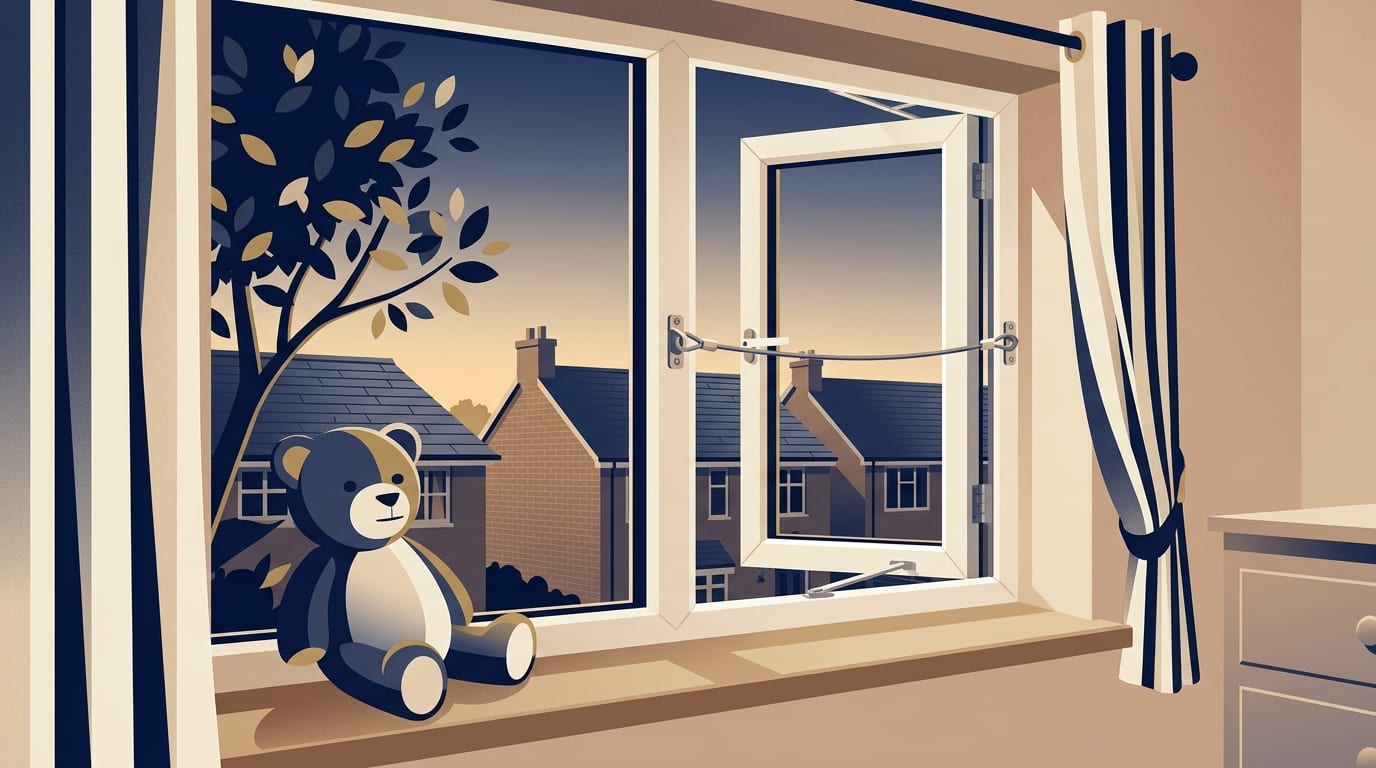
A window restrictor lets a window open a little for fresh air but stops it opening far enough for a child to climb or fall through. Safety advice is to fit them on all windows above the ground floor to prevent serious accidents.
What a window restrictor does
The primary goal of a restrictor is to keep young children safe without sealing a room completely. The Child Accident Prevention Trust states that nationally one child under five is admitted to hospital every day after falling from a building. These falls often happen from open windows, as well as from balconies.
A restrictor provides a physical limit that adults can operate easily if necessary but that young children cannot defeat. It usually consists of two parts. One part fixes securely to the static window frame, and the other attaches to the opening part of the window. A strong link between them stops the window opening beyond a set point.
Installing a restrictor is only part of the solution for child safety. The Royal Society for the Prevention of Accidents advises that you must never place furniture near windows. This is especially important in bedrooms, because toddlers can use beds, chairs or toy boxes to climb up to the glass. Moving furniture away reduces the chance of a child reaching the window handle in the first place.
Which windows need to be restricted
You should look at every window in your home that sits above the ground floor. The higher the window, the greater the risk of a severe injury from a fall. The National Child Mortality Database notes that RoSPA recommends windows above the ground floor are fitted with restrictors to prevent children falling out.
You should prioritise the rooms where children spend the most time unsupervised. This includes children sleeping in their own bedrooms, playrooms on upper floors, and upstairs landings where a child might wander. Bathrooms are also a significant risk if a child can climb onto the toilet or bath to reach the window handle.
Here are the windows you should check and secure first:
- Bedrooms where children sleep or play on the first floor or higher.
- Upper floor landings and hallways with low window sills.
- Bathrooms where sanitaryware provides an easy step up to the window.
- Any window where the glass is less than 800 mm from the floor level.
- Windows in rented properties where new tenants have just moved in with young children.
You also need to think about security from the outside. Police crime prevention advice states that window opening restrictors allow you to ventilate your home, but you must make sure they cannot be disengaged from outside. A restrictor is there to stop falls rather than to secure the house, so close and lock the window fully when you go out.
Types of window restrictor
There are several types of restrictor designed for different window frames and opening styles. The right choice depends on the material of your window and whether it serves as a designated fire escape route.
Cable restrictors are a common choice for existing windows. One end fixes to the frame and the other to the opening part of the window. A strong metal cable connects the two parts and usually locks into place with a key. These work on most frame materials including timber, aluminium and plastic.
Arm or hinge restrictors are built into the window stays, the hinged arms that hold an opening window, on many uPVC windows. They catch when the window reaches a set point, and an adult releases a catch or lever to open it further. The guide to uPVC window lock repair and replacement covers the locks and handles on these windows.
Push button or catch restrictors do not use a key at all. An adult releases them by pressing a button or moving a spring loaded catch by hand. They usually spring back into place and re-engage automatically when the window is pulled closed again.
Sliding sash windows require a completely different approach. You fit metal stops into the side frames that physically block the lower window from sliding up past a certain point. If you want to know more about securing this traditional style of window, read the guide on sash window locks and how to make sash windows secure.
How far a restricted window should open
Keep the opening of a restricted window to no more than 100 mm. That gap lets fresh air in but is meant to be too small for a young child to get through.
This 100 mm measurement is standard across several sets of official guidance. Health and Safety Executive guidance for health and social care premises states that windows large enough to allow people to fall out should be restrained. It says the opening should be restricted to 100 mm or less.
Council guidance for rented homes uses the same figure. Cornwall Council guidance for landlords notes that catches restricting the distance a window can open up to 100 mm fitted above ground floor level help prevent falls. The Master Locksmiths Association also uses this figure, stating that sliding sash windows can be fitted with restricting devices that allow them to open a maximum of 100 mm for ventilation while the home is occupied.
Once a restrictor is fitted, check the gap at its widest point, which on a hinged window is usually the edge furthest from the hinges. If it is more than 100 mm, ask the fitter to adjust it.
Getting out in a fire
Child safety must always be balanced against fire safety. Police advice is clear that you must always give yourself a means of escape so that you can get out of your home quickly in the event of a fire. If a window is your only way out of a room, a restrictor must not trap you inside.
RoSPA and local council guidance agree that any opening limiter should be easy to override by an adult in an emergency. On a window that is the designated escape route from a room, you must choose a restrictor an adult can release by hand without a key. RoSPA notes that restrictors incorporating a child safety catch are best because this avoids having to find keys in an emergency.
The Master Locksmiths Association guidelines are strict on this point for home security. They state that where a window is required for emergency egress, it shall not be fitted with any type of key lockable system. Instead, the window should be fitted with laminated glass to maintain security against break-ins. Approved Document B, which covers new escape windows in England, allows opening stays with child-resistant release catches on them, and says the window should be able to stay open without being held.
If a restrictor on another window does need a key, you must plan for an emergency. The government Fire Kills campaign advises that you keep door and window keys in a safe but accessible place near the exit they fit. You must never leave keys in locks where they could fall out or be hard to find in the dark, and you must make sure every adult in the house knows where they are.
What the rules say for new homes and landlords
There is no law that requires every home to have window restrictors. Building Regulations guidance covers guarding at windows in new building work, and councils can act on dangerous windows in rented homes.
Approved Document K of the Building Regulations for England covers protection from falling. It states that the minimum guarding height at opening windows is 800 mm from the floor. The only exception is for roof windows in loft extensions, which fall under different fire safety rules in Approved Document B. Where glazing is less than 800 mm from floor level, council guidance says it requires guarding or safety glass to prevent someone falling through it.
For rented homes, local councils assess the risk of falls from windows under the Housing Health and Safety Rating System. They specifically look at the hazard of falls between levels. A landlord who ignores a dangerous first floor window could face enforcement action if a council inspection identifies a serious risk to a tenant.
If you are a tenant, you should check your tenancy agreement before drilling into window frames. You should ask your landlord for their agreement to fit restrictors if you have young children. A responsible landlord will want the property to be safe and to meet council guidance.
Choosing a restrictor a child cannot undo
A restrictor is only effective if a child cannot bypass it. You need a mechanism that requires the strength, height or dexterity of an adult to release. A simple hook and eye latch is not enough to secure a window against a determined toddler.
A child safety catch, released by pressing a firm button or moving a stiff catch, is the type RoSPA prefers, as covered above. It keeps the release beyond small hands without sending an adult looking for a key in a fire.
You must also ensure the restrictor is physically strong enough to withstand pressure. Department of Health and Social Care estates alert EFA/2013/002 warned that some window restrictors may be inadequate. A determined effort to push the window can sometimes force it open beyond the 100 mm restriction if the device is weak or poorly made.
The Health and Safety Executive guidance for care premises says window restrictors should only be able to be disengaged using a special tool or key. That rule is written for care settings. At home, a window you may need to escape through should still have a release an adult can work by hand without a key, as set out above.
Checking restrictors keep working
A window restrictor takes a lot of strain over its lifetime. People lean against the glass, wind catches the open pane, and children may pull on the handles. You need to check them regularly to ensure they remain safe and secure.
A Department of Health and Social Care alert for health and care buildings advised that where problems are found, damaged restrictors should be repaired or replaced. At home, check yours from time to time and whenever you move into a new property. A weak restrictor offers a false sense of security.
Here is what to check on an existing restrictor:
- The restrictor still limits the opening to 100 mm or less.
- The screws are tight and the window frame shows no signs of splitting or rotting.
- A metal restrictor cable shows no signs of fraying, rust or bending.
- A push button or catch mechanism springs back firmly and works smoothly for an adult.
- The key is stored safely nearby if the window is not a fire escape route.
- The restrictor cannot be manipulated or unhooked from the outside.
If a restrictor feels loose or the cable looks damaged, do not attempt a temporary repair. Have the whole unit replaced, because a damaged restrictor may not hold if a child pushes or leans on the window.
Who can fit them and what it costs
You can hire a local locksmith or a specialist window repair company to fit restrictors. Because fitting them correctly affects both child safety and your fire escape routes, professional installation provides peace of mind. A professional will know exactly where to position the screws without damaging the glass or the internal window mechanism.
A tradesperson will usually price the job as a charge for their labour plus the cost of the restrictor parts. There are many different brands and styles of restrictor, so there is no single published price for the parts themselves. You should ask the locksmith to supply and fit the units, and request a total price for all the windows at once.
Labour costs vary depending on where you live and when you book the work. Routine jobs like fitting restrictors should be booked during standard weekday hours to avoid premium emergency rates.
The table below shows starting hourly labour rates for locksmiths.
|
Time and location |
Starting hourly labour rate |
|---|---|
|
Standard daytime hours |
From £85 |
|
London daytime hours |
From £95 |
|
Out of hours (after 8pm) |
From £105 |
These figures are typical published prices for 2026 and local quotes will differ.
Always ask whether VAT is included in the quote because not all locksmiths charge it. You should also check that the business has a real local address and can show you identification when they arrive.
Common questions
Are window restrictors building regulations?
Approved Document K sets a minimum guarding height of 800 mm at opening windows for building work in England. Approved Document B gives guidance for new emergency escape windows and allows opening stays with child-resistant release catches on them. No regulation requires restrictors in every home, but RoSPA recommends them on windows above the ground floor.
Can you put a window restrictor cable on uPVC?
Yes, cable restrictors can be screwed securely into uPVC window frames. A fitter will use fixings suited to uPVC frames. You can also get arm restrictors that fit neatly into the existing hinges of a uPVC window.
What is a window safety catch?
A window safety catch is a type of restrictor that you operate by hand rather than with a key. An adult presses a spring loaded button or lifts a lever to release the window fully. These are the best choice for fire escape windows because they allow you to get out quickly without searching for a key in the dark.
Can a landlord refuse to fit window restrictors?
Councils assess falls from windows under the Housing Health and Safety Rating System. If a window poses a serious hazard, the council can force the landlord to act. Tenants should check their tenancy agreement and get the landlord's agreement before changing locks or drilling into frames themselves to fit restrictors.
Next steps
If you are ready to make your upstairs windows safe, here is a short checklist of what to do next.
- Walk through your home and identify every window above the ground floor that a child could reach.
- Decide which of those windows are designated fire escape routes.
- Choose restrictors an adult can release by hand for escape windows, and if any others lock with a key, keep that key near the window but never in the lock.
- Measure the opening to ensure the final gap will be 100 mm or less.
- Check that no beds or chairs are left near the windows.
- Ask a local professional for a total fixed price to supply and fit restrictors to all those windows at once.
To get started, you can find a locksmith near you to check your windows and provide a clear, fixed quote for the work.
Related Guides
Garden Gate Locks and How to Secure a Side Gate
Why the side gate matters, the main types of garden gate lock, how to make a gate hard to climb, the planning height limits and what to ask a locksmith.
Sash Window Locks and How to Make Sash Windows Secure
How sash windows are locked, why the central catch is not enough, how many locks each window needs, how sash stops work and what to know in a listed home.
Door Chains and Door Viewers to Check Who Is at the Door
How door chains, door limiters and door viewers work, which ones are police approved, how to use a chain safely when someone knocks and what fitting costs.