
Door Chains and Door Viewers to Check Who Is at the Door
TopRatedLocksmiths.co.uk · 7 October 2026
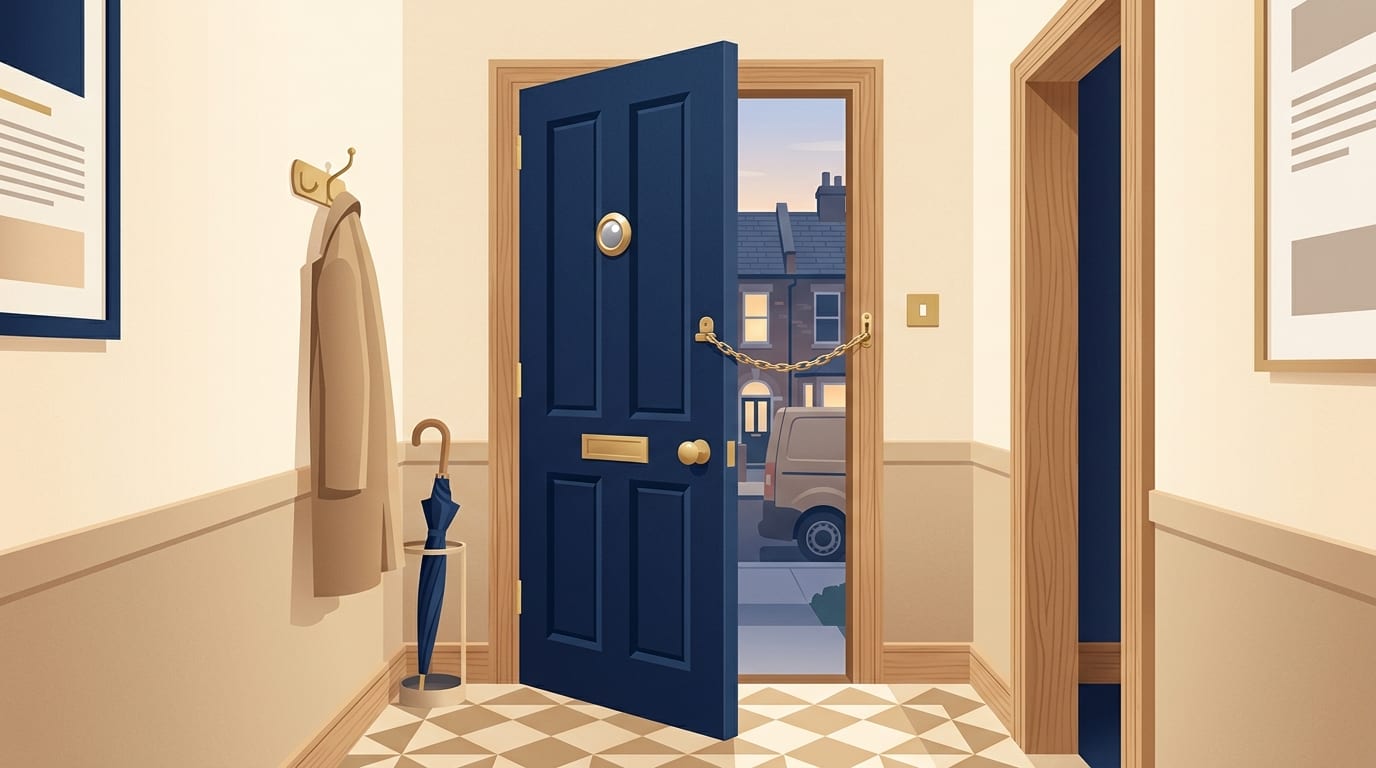
A door chain or limiter lets you open the door a little to speak to a caller, while a door viewer lets you see who is there first. Neither of these is a lock, but police advice is to use them every time an unexpected caller knocks. They are cheap to buy and simple to fit, offering extra security against distraction burglary for you or an older relative who lives alone. By checking a visitor before opening up fully, you keep control of your front door.
What a door chain does and does not do
A door chain is designed to stop an intruder entering when you open the door. It gives you a physical barrier against distraction burglary, where someone tries to talk their way inside or push past you while you are distracted. These chains are cheap to buy and simple to fit, which makes them a popular choice for elderly or vulnerable people who want to feel safer at home.
They are not a replacement for a door lock. You should only ever add a chain as extra security to support your main locks. A chain or limiter allows you to open the door just enough to see who is outside and pass small items or identity cards through the gap. If you want to strengthen your front door against a forced break-in, a chain will not do that job on its own. Your main mortice deadlock or euro cylinder is what keeps the door secure overnight.
The MLA warns that chains can be fitted poorly. If the screws are too short or the chain is fixed to weak wood, it may not hold against a strong push, so a professional fitting is worth considering.
Door chains and door limiters
The two main types of chain are standard non-locking door chains and lockable door chains. Standard chains are a familiar sight and consist of a metal chain fixed to the frame that slides into a track fixed to the door. These standard chains suit wooden doors perfectly because the screws can bite deeply into the solid timber frame and the heavy body of the door.
When you slide the chain into place, it physically limits how far the door can swing open. This means you can talk to a caller, sign for a parcel or check an identity badge without leaving your home wide open. Because standard chains do not need a key, they are quick to put on when someone knocks.
It is vital that the track is fitted at a height where everyone in the household can reach it easily. If you are fitting one for an older parent, make sure they can slide the chain in and out without stretching or bending. A poorly positioned chain is frustrating to use and might end up being ignored entirely.
Chains for uPVC and composite doors
Fitting a chain to a uPVC or composite door requires a different approach. Standard screws will not hold securely in the hollow chambers of a uPVC frame, and forcing them in can crack the plastic. Most chains can be fitted to uPVC doors if the correct fixing screws or security rivets are used to spread the load.
The best option for these doors is often a door chain restrictor with a ring. This type of restrictor suits uPVC and composite doors with a lever handle. Instead of a track screwed onto the face of the door, the chain has a metal ring at the end that drops over the internal door handle. When the handle is pulled down to open the door, the chain prevents it from opening more than a few inches.
Before you fit any chain to a modern uPVC or composite door, you must check with your insurer and the door supplier. Drilling into the plastic frame to fit the anchor point might affect your door warranty. A locksmith can advise on the right fixings, but only the door supplier can confirm what its warranty allows.
Lockable door chains
Lockable door chains take the concept a step further by allowing you to lock the chain from the inside and the outside. Some models are child-proof and only open with a key.
Because they lock securely, these chains suit glass panel, aluminium and uPVC doors. If a burglar breaks a glass panel near the door, they cannot simply reach in and slide the chain off the track to let themselves in. The key mechanism keeps the chain firmly in place until you choose to unlock it.
You must be very careful with how you use a lockable chain. If the door is left on the chain and locked, there is no emergency exit. You will need to find the key to get out, which is dangerous if you need to leave the house quickly. For this reason, a lockable chain should only be used when you are actively answering the door, never left locked overnight.
Door viewers and digital viewers
A door viewer is an optical device fitted through a door to enable observation without opening the door. You might know this simply as a peephole or a spy hole. It uses curved glass lenses to give you a wide-angle view of your doorstep. If you cannot see who is there, do not open the door.
For a clearer picture, you can upgrade to a digital door viewer. This lets you see who is at the door before opening it by showing the outside view on a small screen inside your hallway. Common features include:
- Easy fitting to a new or existing door
- Easy removal if you move house
- A built-in motion sensor
- An LCD display screen
- HD video and image recording
These digital viewers offer excellent visibility, making them ideal for older residents or rented properties. If you live in a block of flats, you might not have a direct view of the main entrance from your own front door. Video or audio intercoms suit flats perfectly for this reason. They can help older people talk to visitors without going to the door at all. You can confirm who is buzzing your flat from the comfort of your living room and let them in remotely if you choose to.
Using the chain when someone knocks
Having a chain and a viewer is only useful if you use them correctly every time. Police forces across the country offer clear advice on how to handle unexpected callers to prevent doorstep crime and distraction burglary. Following a strict routine removes the pressure of dealing with a stranger on the doorstep.
Make this routine a habit for yourself or share it with older relatives:
- Do not open the door if you are not sure who is at your door.
- Always put the chain on before you open the door.
- Check the caller's identity by phoning the company using a number from an official website, phone book or utility bill.
- Never use a telephone number that the caller provides.
- Ask them to make an appointment when a family member, friend or neighbour can be there, as genuine callers will not mind.
- Do not be forced into making a quick decision on the doorstep.
- Do not allow uninvited callers into your home and beware of callers claiming to be builders who point out a problem with your home.
- Refuse any offer to be taken to the bank to withdraw money.
If an unexpected caller makes you feel alarmed or intimidated, close the door and call 999 immediately. You should also call 999 if the caller refuses to give details or does not show a genuine ID card.
Many service providers run password schemes for their vulnerable customers. You can agree a password with your gas, electricity or water company in advance. When their meter reader or engineer arrives, they must tell you the password through the closed door before you take the chain off.
Fire safety and getting out quickly
Door chains are excellent for security against bogus callers, but they must be managed carefully when it comes to fire safety. The police advice is very clear on this point. Do not keep the chain on all the time as this could delay your exit in the case of fire. When smoke alarms sound, you need a clear, fast route out of the building.
Some people wrongly leave the chain on all the time instead of locking the door properly. A chain is not designed to take the place of your main mortice deadlock or multipoint locking mechanism. When you are inside for the evening, you should lock the door securely and leave the chain off. You only need to slip the chain on when someone knocks.
This rule is even more critical if you have a lockable door chain. If you leave a lockable chain locked from the inside, you have created a trap for yourself and your family. There is no emergency exit if the door is left on the chain and locked, because you would have to find the key in a dark, smoke-filled hallway. Keep your exits clear and only use the chain to check callers.
Standards and police approval
When you buy a chain, look for independent testing. The MLA recommends Secured by Design accreditation, which is widely known as police approved.
For standard chains and limiters, look for a chain tested to TS003, the test specification for door chains and limiters that the MLA door chain guide recommends.
If you have a modern plastic or composite door, the standards are slightly different. For uPVC doors look for a restrictor independently tested to PAS 24 and accredited by Secured by Design.
What it costs to have one fitted
Door chains and viewers are very affordable security upgrades. The parts themselves cost little, and fitting is usually a short job. Because the job is quick, it is an excellent addition if a locksmith is already visiting to change a cylinder or upgrade a lock.
A locksmith can supply and fit chains and viewers on one visit. You will normally pay for the parts plus the locksmith's hourly labour rate. Prices will vary depending on where you live and the time of day you need the work done. Evening and weekend call-outs usually cost more than daytime visits.
This table shows the starting costs for police approved door chains and professional locksmith labour.
|
Security item or service |
Typical cost |
|---|---|
|
TS003 police approved door chain |
From around £10 |
|
Police approved chain for a uPVC door |
From £20 |
|
Standard hourly labour |
From £85 |
|
Hourly labour in London |
From £95 |
|
Hourly labour after 8pm |
From £105 |
These figures are typical published prices for 2026, and local quotes will differ depending on your area. These hourly figures are the average prices from MLA approved locksmiths. Always ask whether VAT is included in the quote before you agree to the work, because not all locksmiths charge it. You should also ask if there is a separate call-out fee on top of the hourly rate, although many independent locksmiths do not charge one.
Common questions
What is a door chain lock?
A door chain lock is simply another name for a standard or lockable door chain. It is important to remember that it is not a replacement for a main door lock and should be added as extra security only. It allows you to open the door a fraction to speak to strangers safely, but it will not secure your home on its own.
What is the difference between a peephole and a door viewer?
They are exactly the same thing. A door viewer is the technical term for an optical device fitted through a door so you can observe the outside. Peephole is just the common everyday word for it. Both let you identify visitors before you open the door, which is a key part of police crime prevention advice.
How does a peephole camera work?
A peephole camera, or digital door viewer, replaces the traditional glass lens with a digital system. It often features a motion sensor, an LCD display on the inside of the door, and HD video and image recording. This lets you see a bright, clear picture of the caller without having to press your eye against the door, which is very helpful for older residents.
What is a door spy hole?
A door spy hole is just another name for an optical door viewer. It is a small tube containing curved glass lenses that passes straight through the timber or uPVC door. It gives you a wide-angle view of your doorstep so you can check who is knocking without them seeing you inside.
Can I fit a front door restrictor myself?
Chains are easy to fit and cheap to buy, so many people do fit them themselves on wooden doors. However, they can be fitted poorly if you use weak screws that pull out easily. For uPVC doors, you must use the correct fixing screws or security rivets, so it is often safer to have a professional fit it to avoid damaging the internal lock mechanism.
Next steps for your door security
Fitting a chain and viewer is a practical way to protect yourself and your family from doorstep scams. Before you arrange to have one installed, run through this quick checklist to make sure you get the right product for your door.
- Check your door material to see if you need a standard chain for timber or a restrictor with a ring for uPVC.
- Check with your door supplier and insurer about any warranty conditions before drilling into a uPVC frame.
- Look for Secured by Design accreditation and the TS003 or PAS 24 test standards on the packaging.
- Decide if a digital door viewer with an LCD display would be easier for an older relative to use than a standard optical viewer.
- Get a total price including parts, labour, VAT and any call-out fees before the work starts.
A reputable professional will make sure your new restrictor is anchored firmly and works smoothly without compromising your fire exit. The guide on how to find a local locksmith you can trust explains what to check, and you can find a locksmith near you in our directory.
Related Guides
Window Restrictors and How They Keep Children Safe
What window restrictors do, which windows need them, how far a window should open, how to keep a fire escape route and what landlords should know.
Garden Gate Locks and How to Secure a Side Gate
Why the side gate matters, the main types of garden gate lock, how to make a gate hard to climb, the planning height limits and what to ask a locksmith.
Sash Window Locks and How to Make Sash Windows Secure
How sash windows are locked, why the central catch is not enough, how many locks each window needs, how sash stops work and what to know in a listed home.