
What Is a 5 Lever Mortice Lock and Why Does BS3621 Matter?
TopRatedLocksmiths.co.uk · 6 October 2026
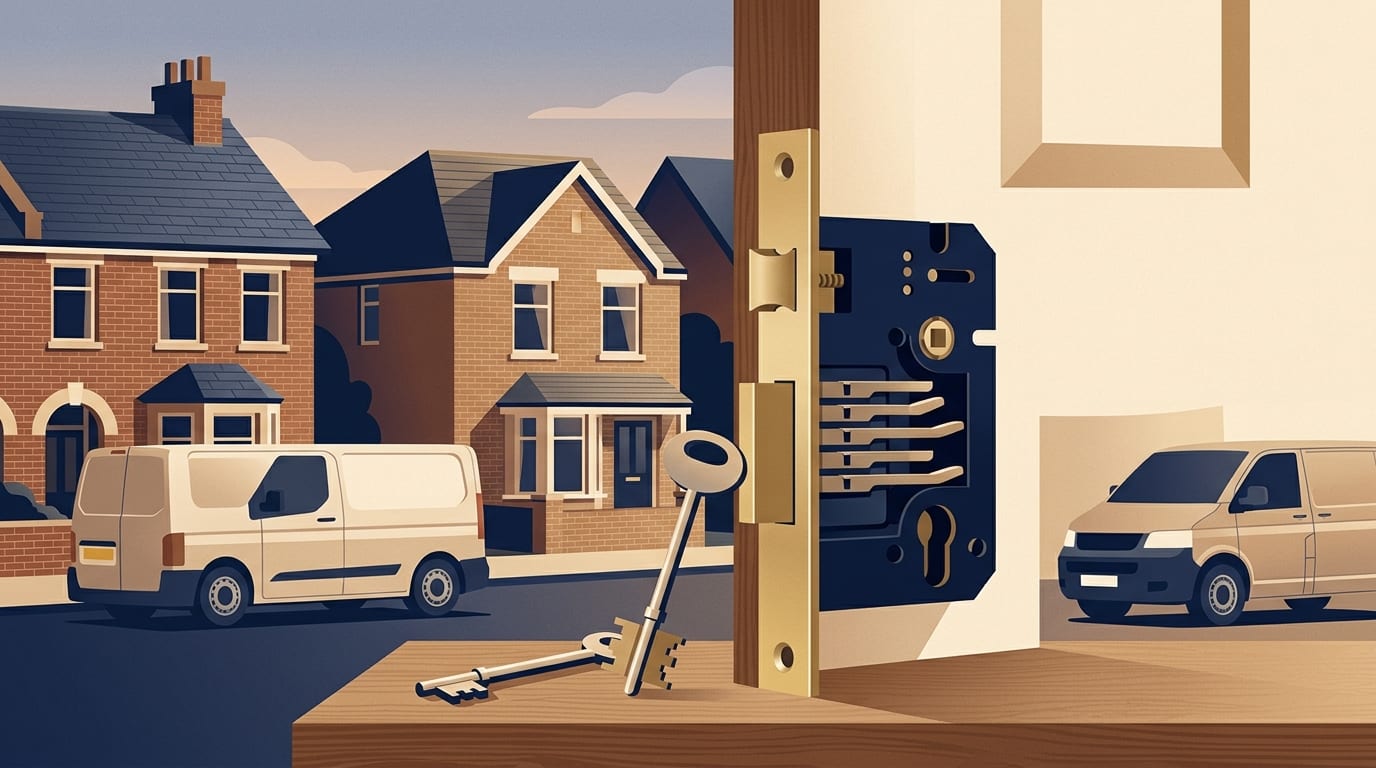
A 5-lever mortice lock is a traditional locking mechanism fitted entirely within the wooden edge of a door. When a lock like this meets the BS3621 standard, it includes specific anti-drill and anti-pick features that provide a high level of security. Checking for the British Standard Kitemark on your door edge is the fastest way to know whether your lock meets the standard many insurance policies mention.
What a mortice lock is
A mortice lock requires a pocket to be cut into the edge of a timber door. The main body of the lock slides into this pocket, which is known as a mortice. This means the entire mechanism is hidden inside the wood. The only parts you can see are the metal faceplate on the thin edge of the door and the keyhole on the front and back.
Because the lock is housed inside the timber, the surrounding wood provides much of its strength. A metal plate called a keep is recessed into the door frame opposite the lock. When you turn the key, a solid metal bolt shoots out of the lock faceplate and rests inside the keep. This creates a strong physical barrier that stops the door from opening.
Mortice locks are the traditional choice for wooden front and back doors in the UK. They are not used on modern plastic or composite doors. Those modern doors rely on a multipoint locking mechanism, which is a metal strip of hooks and bolts worked by lifting the door handle. If you have a uPVC door, you will need a euro cylinder instead, and you can read more about those in our anti snap locks guide.
Mortice deadlocks and mortice sashlocks
The two main types of mortice lock are the deadlock and the sashlock. A 5-lever mortice deadlock is fitted within a wooden door and operated with a key from both sides. It has a single rectangular metal bolt that moves when you turn the key. There are no handles involved with a deadlock. You choose a deadlock when you only want a keyhole on the door and nothing else.
A mortice sashlock differs from a deadlock by including a latch as well as a bolt. The latch is a sprung piece of metal with an angled edge. It is operated by a standard door handle. This latch allows you to push the door shut and keep it closed without having to lock it with a key.
When you leave the house or go to bed, you turn the key in the sashlock to throw the main rectangular bolt alongside the latch. You choose a sashlock when you want a handle on the door for daily convenience. Both types are fitted inside the wood, and both are available in BS3621 versions.
3-lever and 5-lever locks compared
The levers are flat metal plates inside the lock that only let the bolt move when the right key is turned.
A 3-lever lock contains three of these metal plates. A 5-lever lock contains five. Five lever locks are more secure than three-lever locks, which carry a greater risk of key duplication. Because a 3-lever lock has fewer internal parts, there are fewer possible shapes for the key. This increases the chance that a key from another lock might open yours.
A 3-lever mortice lock cannot be Kitemarked to BS3621. They do not offer enough security for an external front or back door. Locksmiths generally only fit 3-lever locks to internal doors, such as a bedroom or an office inside a home, where high security is not required.
What BS3621 means
BS3621 is a British Standards Institution standard for thief resistant locks, first introduced in the 1960s, for wooden and timber doors in homes. The standard has been updated multiple times to deal with new ways criminals try to break in. The latest version is BS 3621:2017+A1:2024.
A standard 5-lever deadlock that does not conform to BS3621 will usually have no hard plates to protect against drilling and may only have been tested by the manufacturer. A BS3621 lock is certified by BSI, which is independent of the lock maker.
To pass the test, a BS3621 mortice lock must have:
- At least 5 levers and at least 1000 key differs, meaning at least 1000 different key patterns.
- Anti-pick features.
- Hardened plates to protect against drilling.
- A bolt that reaches at least 20mm into the door frame.
How to tell if your lock meets BS3621
You can check the standard of your lock without taking anything apart. Open your door and look at the metal faceplate set into the narrow wooden edge. To check a lock, look for the British Standard Kitemark engraved on the lock and the number BS3621 stamped on it.
The Kitemark is a small symbol shaped a little like a heart. The number BS3621 will be stamped directly below or next to it. If you see a Kitemark but a different number, or no Kitemark at all, your lock does not meet this specific standard.
On older doors, the lock faceplate is sometimes covered in thick layers of gloss paint. If the faceplate is painted over, you will not be able to read the stamp. You can carefully scrape the paint away from the flat metal surface with a flat blade to reveal the engravings underneath.
Why insurance policies mention BS3621
BS3621 locks are often called insurance-approved, but they are not approved by insurance providers. The certification is done by the British Standards Institution. Insurance companies simply use this independent standard as a benchmark for home security.
To comply with the requirements of most insurers, locks on traditional external timber doors that need a key to exit are generally certified to BS 3621:2017+A1:2024. Some insurers insist on BS3621 and others do not, so it is down to the individual to check with their insurer. You must read your own policy wording to see what is demanded for your property.
Insurers will on occasion accept locks already installed that meet earlier versions of the standard. Where a lock is not certified, the policyholder should get the insurer's written confirmation that their setup is acceptable. If your policy demands a BS3621 lock and you suffer a break-in without one fitted, your home insurance might not cover your losses.
Thumb turn escape locks and fire safety
A standard BS3621 mortice lock requires a key to open it from both the inside and the outside. This can present a risk in a fire if the key is missing or you cannot see clearly in a dark hallway. Keys for key-only locks should be kept within easy reach of the occupant but out of reach of an intruder. You must ensure you can find your key immediately in an emergency.
For homes where a quick exit is needed, such as a block of flats, BS 8621 locks open from the inside without a key, usually with a thumb turn. A thumb turn is a small knob on the inside of the door that you twist to retract the bolt.
There is also a standard for a lock that does both. BS 10621 is a rarely used dual mode lock combining both functions. It has a secure mode, set with a key from outside, in which it cannot be opened from the inside at all, so that mode is only for when nobody is indoors.
Pairing a mortice lock with a night latch
A night latch, commonly called a Yale lock, is a surface latch fitted to the inside of a timber door. It automatically clicks shut when you pull the door closed. A night latch is only truly secure if it is BS3621 approved or is fitted alongside a 5-lever mortice deadlock that conforms to BS3621.
This is why traditional timber front doors usually have two locks. The night latch provides convenience during the day, while the mortice lock provides the main physical strength when you lock up at night. BS3621 locks include rim locks such as night latches as well as mortice deadlocks and sashlocks.
There are specific rules for brand new homes in England. Approved Document Q sets the building regulations for doors into a new home, which must be secure doorsets. They must be either tested to PAS 24 or built as bespoke timber doorsets to its Appendix B.
For a bespoke timber front door, Appendix B asks for a multipoint lock to PAS 3621, PAS 8621 or PAS 10621. Where that is not practical, it asks for a mortice lock to BS 3621, BS 8621 or BS 10621 with a surface mounted rim lock to the same standard, 400mm to 600mm apart. This rule applies to new dwellings only and is about the whole doorset, so you do not need to measure the distance between the locks on your existing home.
Fitting or upgrading a mortice lock
If your current lock does not meet your insurance requirements, an approved locksmith can upgrade existing locks to BS3621. They will remove the old lock from the mortice pocket and fit the new one. If the new lock case is slightly larger than the old one, they will chisel out extra wood to make it fit flush.
If you want to fit an entirely new mortice lock to a door that only has a night latch, the thickness of the wood matters. An additional mortice deadlock needs a door at least 44mm thick. Cutting a deep pocket into a thinner door will remove too much wood and leave the door structurally weak.
A mortice lock change usually takes 30 to 60 minutes. If you are locked out because you have lost your key, a good locksmith will try non-destructive entry first. This means picking or bypassing the lock rather than drilling it. You should ask the locksmith on the phone how entry will be gained and whether drilling is likely.
Consumer rights and avoiding scams
There is no government licensing of locksmiths in the UK. Anyone can buy a set of tools and trade as a locksmith, which is why checking a firm's background matters. The Master Locksmiths Association (MLA) runs a voluntary approval scheme. Its approved companies are vetted, have criminal record checks, employ locksmiths who have passed the MLA exam and are inspected regularly.
Under the Consumer Rights Act 2015, a locksmith service must be carried out with reasonable care and skill. The work must be done at a reasonable price if none was agreed beforehand, and within a reasonable time. If the work is poor, you have a right to have it put right or get your money back.
Under the Consumer Contracts Regulations 2013, there is normally a 14-day cancellation period for work arranged at home or by phone. This cooling-off period does not apply where you specifically asked for a visit for urgent repairs, such as being locked out at night. However, extra work sold during that visit, such as upgrading other locks in the house, is not covered by the exception.
You should be aware of common scams and poor practices in the unregulated locksmith trade, which often include:
- National call centres advertising as a local business and passing the job to whoever is nearest.
- A very low price quoted on the phone that multiplies once the locksmith is on your doorstep.
- Drilling a lock to force you to buy a replacement when it could have been picked or bypassed.
- Refusing to give a firm price before starting the work.
- Demanding cash only and refusing to provide a written invoice or company address.
- Arriving in an unmarked vehicle with no personal ID.
What a new mortice lock costs
Locksmith jobs are usually priced as labour plus parts. You will either be charged by the hour or quoted a fixed price per job. Many locksmiths charge no separate call-out fee but some do, and VAT may or may not be included. You must ask for a total price, including parts, VAT and any call-out charge, before the work starts.
The price is driven by the type and security grade of the lock, your location, and the time of day. London and the South East cost more for labour. Evenings, nights, weekends and bank holidays cost more than daytime hours. If your lock is stiff but not broken, a repair will cost less than a full replacement. A mortice lock repair normally costs £55 to £80. If your problem is not urgent, waiting until normal working hours will help you avoid premium emergency rates.
The first table below shows the cost of buying the lock hardware on its own without any labour. Upgrading to a BS3621 lock costs only slightly more in parts than a standard lock.
|
Lock type |
Typical hardware cost |
|---|---|
|
3-lever mortice deadlock |
From £24 |
|
5-lever mortice deadlock |
From £28 |
|
5-lever mortice deadlock to BS3621 |
From £38 |
|
5-lever mortice sashlock to BS3621 |
From £40 |
|
BS3621 night latch |
From £100 |
These figures are typical published prices for 2026 and local quotes will differ.
The second table shows the total cost to have a locksmith supply and fit the lock for you.
|
Service required |
Typical fitted price |
|---|---|
|
Mortice lock repair |
£55 to £80 |
|
Single mortice or night latch replacement |
£90 to £170 |
|
Single mortice or night latch replacement (London and South East) |
£120 to £220 |
|
Mortice lock to BS 3621 supplied and fitted outside London |
£120 to £220 |
|
5-lever mortice deadlock lock change |
£120 to £190 |
|
Mortice lock (deadlock or sashlock) replacement |
From £148 |
These figures are typical published prices for 2026 and local quotes will differ.
Common questions
Are 3-lever mortice locks secure?
A 3-lever mortice lock provides basic security and is generally only used for internal doors. It cannot meet the BS3621 standard because it does not have enough levers to provide a high number of unique key shapes. This carries a greater risk of key duplication compared to a 5-lever lock.
Does my home insurance require a BS3621 lock?
Many policies mention BS3621 for external timber doors that need a key to open from inside, and the current version is BS 3621:2017+A1:2024. Some insurers insist on it and others do not. You must check your individual policy wording and get written confirmation from your insurer if your lock is different.
What is the difference between a deadlock and a sashlock?
A mortice deadlock relies solely on a key to throw a rectangular bolt into the door frame. A mortice sashlock includes that same bolt but adds a sprung latch operated by a door handle. Both offer the same level of security if they meet the same British Standard, but a sashlock allows you to keep the door closed without locking it.
Can you fit a mortice lock to a uPVC door?
No, mortice locks are designed to be fitted into a pocket cut inside a traditional timber door. A uPVC or composite door uses a multipoint locking mechanism that runs down the edge of the door, operated by a euro cylinder.
What to check before you hire a locksmith
Before you agree to have a locksmith visit your property, you should ask a few clear questions on the phone. A reputable professional will be happy to answer them and confirm their pricing structure.
- Ask for a total price including parts, labour, VAT and any out-of-hours charge before work starts.
- Ask whether they charge a separate call-out fee just for turning up.
- Ask exactly what standard the new lock will meet, ensuring it is a BS3621 mortice lock if your insurance requires one.
- Ask how entry will be gained if you are locked out, and whether they expect to drill the lock.
- Check the business has a real local address and consistent reviews over time.
- Check any claim of MLA approval by searching for the firm on the Master Locksmiths Association website.
- Ask the locksmith to show their ID on arrival and provide a written invoice when the job is done.
Taking a few minutes to check these details will help you avoid being overcharged and make sure the new lock suits your door. If you need to arrange an upgrade or a repair, you can find a locksmith near you to get a clear quote for the work.
Related Guides
Window Restrictors and How They Keep Children Safe
What window restrictors do, which windows need them, how far a window should open, how to keep a fire escape route and what landlords should know.
Garden Gate Locks and How to Secure a Side Gate
Why the side gate matters, the main types of garden gate lock, how to make a gate hard to climb, the planning height limits and what to ask a locksmith.
Sash Window Locks and How to Make Sash Windows Secure
How sash windows are locked, why the central catch is not enough, how many locks each window needs, how sash stops work and what to know in a listed home.