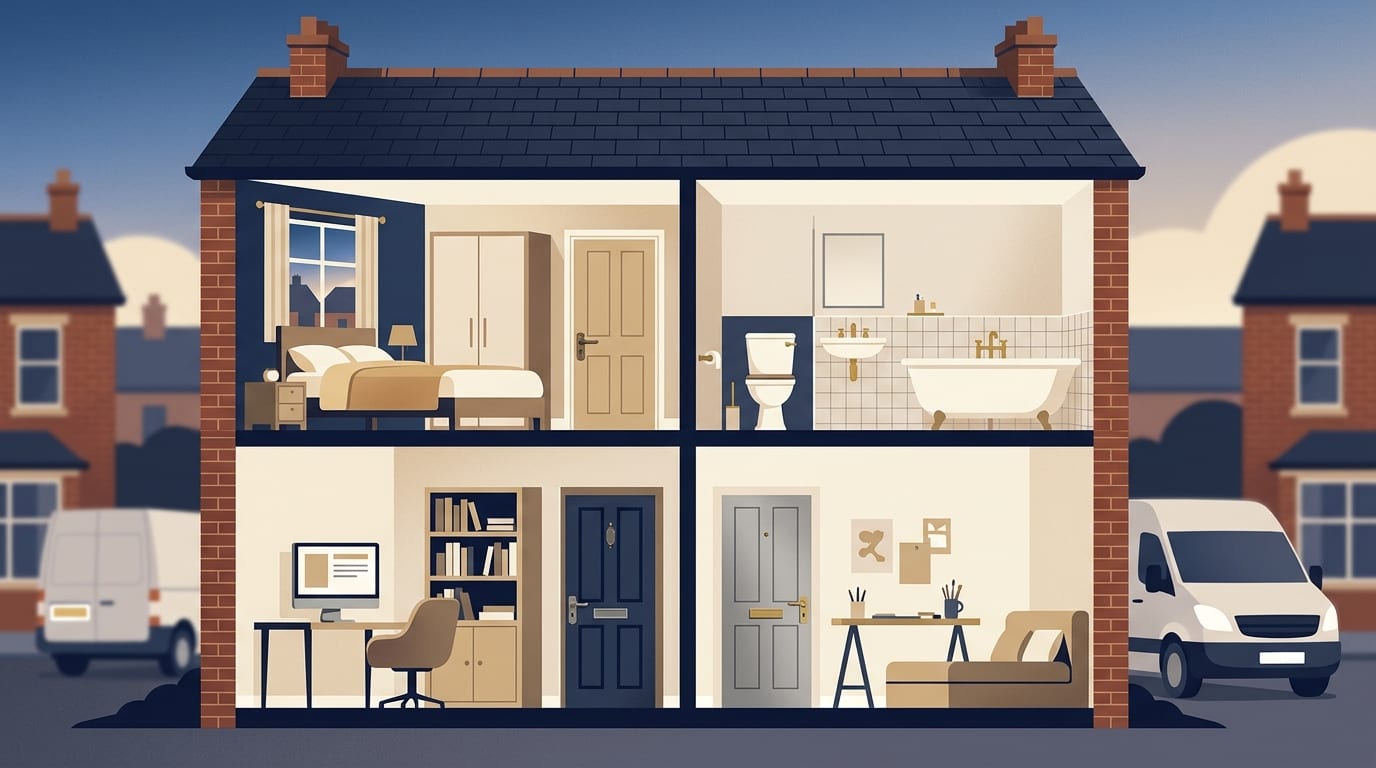
When choosing types of door locks for inside your house, the main rule is that an internal lock is mostly about privacy. Nobody should ever be trapped behind an internal door, so the first test is whether the person inside can always get out without a key, and whether someone outside can open it in an emergency.
Internal locks are about privacy and safety, not security
Locks on the inside of a house serve a very different purpose to the locks on your front or back door. While external doors are designed to keep intruders out, internal doors are designed to give people privacy while they wash, sleep or work. This means the mechanisms are generally simpler and focus on easy operation rather than heavy physical security.
Because privacy is the goal, you rarely need a complex locking system for a standard internal room. Heavy security locks are not suited to internal doors, and any lock that stops someone getting out quickly is a hazard. You have several options depending on the room and who uses it.
- Privacy latches operate with a simple thumb turn on the inside and an emergency release slot on the outside.
- Sashlocks are fitted inside the timber door and use a key to operate both a latch and a locking bolt.
- Thumb turn locks allow you to secure the door from the inside without needing a key to get out.
- Surface mounted bolts slide into a keep on the door frame and offer simple privacy from one side.
- Keyed rim locks sit on the surface of the door and require a key to open from the outside.
Bathrooms and toilets
The most common place for an internal lock is the bathroom or toilet. For these rooms, a thumb turn privacy lock is the standard and safest choice. You operate it by twisting a small dial on the inside, which throws a bolt or stops the handle from moving. This gives complete privacy without requiring a key that could get lost or left on the wrong side of the door.
Crucially, a bathroom lock should have an emergency release on the outside. This usually looks like a small slot that can be turned with a coin or a flat screwdriver. This feature is vital because people can slip, become unwell, or simply get stuck inside small rooms with no other way out.
Children can get locked in. A Cornwall fire service report from April 2016 described crews using small tools to release a child locked in a bathroom.
Bedrooms and children's rooms
Adult bedrooms often need a lock for privacy, especially in shared houses. A thumb turn or a snib on the room side is the best approach, so the door opens from the inside without a key. A snib is a small button or slider that holds the latch in place, commonly seen on surface mounted locks. This ensures you can secure the room when you are in it, but can leave quickly if you need to.
For children's bedrooms, take more care. You should never lock a child in their room, and you should not fit locks that allow a child to accidentally lock themselves in. Locked in children risk being trapped in a fire, which is why escape routes must always remain clear and easy to open from the inside.
If you want to keep young children out of a particular room, make sure the lock can never trap anyone inside it. Safety and the ability to escape must always come before privacy when children are involved.
Home offices and rooms with valuables
Many people now work from home and want to secure expensive laptops, monitors or sensitive documents. A home office is one of the few internal rooms where a key lock, such as a traditional sashlock, is fine to use. A sashlock has a handle to open the door normally, plus a separate keyhole to lock it securely when you leave the room.
Even with a key lock, the room still needs a safe way out for whoever is inside. You must ensure you do not lock yourself in and lose the key, or allow someone else to lock you in from the hallway. It is easy to become trapped if the only key is taken away while you are working.
If your main concern is protecting small, high value items rather than the whole room, you might not need a lock on the door at all. You can consider fitting a safe inside the room instead, which provides better security for specific items. You can read more about how to choose a home safe to keep your valuables secure without altering your internal doors.
Rooms let to lodgers and tenants
If you rent out rooms in your house, there are extra rules to think about. For houses in multiple occupation, the Elmbridge Borough Council guidance revised in August 2018 states that escape doors should be openable from the inside without the use of a key. This includes final escape doors such as front and rear doors, as well as bedroom doors. Thumb turn or snib action locks to the room side are usually required.
The Master Locksmiths Association guidelines also tell people to consider the means of escape in the event of fire before locks are engaged and keys removed. Escape locks that can be opened from the inside by a single action without a key are acceptable to insurers subject to written confirmation. This means a tenant can turn a dial and push the handle to get out, rather than hunting for a key.
You must also be very careful about the law when it comes to changing locks on rented rooms. In England, GOV.UK says a landlord who changes the locks to keep a tenant out without a court order commits illegal eviction, which is a criminal offence. Councils can prosecute landlords or impose fines of up to £40,000 for this. Tenants, on the other hand, should check their tenancy agreement and get the landlord's agreement before changing or adding any locks themselves.
The rules differ if you have a lodger. According to Citizens Advice, if you share living space with your landlord, they can act to make you leave as long as they do not threaten or harass you, and they might change the locks while you are out. They must give reasonable notice if there is no agreed end date. If you only share spaces like corridors or stairs, your landlord must give at least 28 days notice in writing. Because the law is complex, you should always speak to Citizens Advice or Shelter for your own situation.
Getting out in a fire
Fire safety is the single most important factor when choosing types of door locks for inside your home. If an internal door stands between a person and the way out, it should be easy to open from the inside.
This table shows typical lock choices for different rooms and the main safety rule for each.
|
Room |
Suitable lock type |
The key rule |
|---|---|---|
|
Bathroom or toilet |
Privacy latch with thumb turn |
Should have an emergency release on the outside |
|
Adult bedroom |
Thumb turn or snib |
Openable from inside without a key |
|
Home office |
Sashlock or key lock |
Occupant must not be locked in |
|
Lodger room |
Thumb turn to room side |
Openable from inside without a key |
These are suggested lock choices based on the guidance above, and the rules for your own home or rented room may differ.
Fire doors and what not to change
Some internal doors are specially made fire doors, designed to hold back smoke and flames for a set period.
You must not alter fire doors without professional advice. Drilling into a fire door to fit a new lock can affect its fire rating, so get advice first. If you need to secure a fire-rated door, you can read our guide on fire door locks and fire exits to understand the exact requirements.
Choosing a quality lock and who fits it
When you need to fit or replace an internal lock, a professional locksmith can do the job cleanly and ensure the door frame is not damaged. Jobs are usually priced as labour plus parts, either by the hour or as a fixed price per job. Price is driven by the time of day, your location, the type of lock, and how entry is gained if you are locked out. Evenings, nights, weekends and bank holidays cost more, and London and the South East are generally more expensive.
There is no government licensing of locksmiths in the UK, meaning anyone can trade as one. This is why vetting matters. The Master Locksmiths Association (MLA) runs a voluntary approval scheme. Its approved companies are vetted, have criminal record checks, employ locksmiths who have passed the MLA exam and are inspected regularly. Under the Consumer Rights Act 2015, a service must be carried out with reasonable care and skill, at a reasonable price if none was agreed, and within a reasonable time, with a right to have poor work put right or your money back.
If you arrange work at home or by phone, the Consumer Contracts Regulations 2013 normally provide a 14-day cancellation period. This does not apply where you specifically asked for a visit for urgent repairs, although extra work sold during that visit is not covered by the exception. When hiring someone, watch out for common scams.
- National call centres often advertise as a local locksmith and pass the job to whoever is nearest.
- A very low price quoted on the phone frequently multiplies once the person is on the doorstep.
- Rogue operators may drill a lock that could easily have been opened without damage.
- Some will replace a whole multipoint mechanism when only the cylinder or gearbox had failed.
- Poor tradesmen might fit cheap cylinders while charging premium prices.
- Bad operators often refuse to give a price before starting the work.
- Demanding cash only with no invoice, no company name and no address is a clear warning sign.
- Arriving with no ID in an unmarked vehicle is a common trait of unvetted workers.
Understanding lock terms and mechanisms
While internal doors use relatively simple locks, discussing security with a locksmith often involves specific trade terms. Understanding these terms helps you know exactly what you are paying for, especially if you are upgrading external doors at the same time. A mortice deadlock and sashlock are fitted inside a timber door, requiring a pocket to be cut into the wood. A night latch or rim lock is the surface latch often called a Yale lock, which sits on the inside face of the door.
The key barrel for a night latch is called a rim cylinder. On modern uPVC and composite doors, the barrel is known as a euro cylinder. This cylinder operates a multipoint locking mechanism, which is the strip of hooks and bolts worked by lifting the handle. The central part of that mechanism is called the gearbox. If you have several doors, you can ask for them to be keyed alike, meaning multiple locks work from the very same key.
Locksmiths also use specific standards and techniques. Non-destructive entry means picking or bypassing a lock rather than drilling it. Lock snapping is a known weakness of euro cylinders, which is why snap-resistant cylinders are used. Boarding up is the process of securing a property temporarily after damage. If you have car key problems, auto locksmiths are a separate specialism covering vehicle entry, key cutting, transponder and remote programming.
When checking lock standards, BS3621 is the British Standard for mortice and rim locks on timber doors, shown by a Kitemark on the lock faceplate. For euro cylinders, the snap-resistant standards are TS007 three star, or a one-star cylinder paired with two-star handles, and Sold Secure SS312 Diamond. Insurers often ask what locks are fitted, so check your own policy wording rather than guessing what insurers require.
Keys, spares and emergency release
If you do fit a key-operated lock on an internal door, managing the keys properly is essential. The Master Locksmiths Association guidelines state that keys should be kept within easy reach of the occupant but out of reach of an intruder. The MLA guidelines are about domestic property in general, so think about who is in the room and how they would get out.
It is sensible to keep a spare key for every internal lock in a known, safe place elsewhere in the house. If a lodger loses their room key, or a family member accidentally locks a door behind them, having a spare prevents the need to force the door. You should never try to force a locked internal door yourself, as this can cause serious injury and ruin the door frame.
Common questions
What are the different types of locks on doors?
The main types for internal doors are privacy latches with a thumb turn, sashlocks that use a key, and simple surface mounted bolts. External doors typically use mortice deadlocks, night latches, or multipoint locking mechanisms with euro cylinders. The type you need depends entirely on the material of the door and whether it needs to stop intruders or just provide privacy.
How do I know if I have a mortice lock?
A mortice lock is normally fitted inside the door itself, rather than sitting on the surface. You will only see the keyhole and the metal faceplate on the edge of the door when it is open. Sash locks have a handle to operate a latch, while deadlocks do not have a handle and are solely key-operated.
Can I put a lock on my bedroom door if I rent?
You must get your landlord's agreement before changing or adding any locks to a rented property. Fitting a lock without permission can breach your tenancy agreement and damage the door. If permission is granted, the lock should normally have a thumb turn on the inside so you can escape easily in a fire.
Do internal door locks prevent burglary?
No lock guarantees against burglary, and internal locks are generally not designed to withstand a determined physical attack. They provide privacy and slow an intruder down slightly, but true security relies on the locks fitted to your external front and back doors. If an intruder is already inside the hallway, an internal privacy latch will not keep them out for long.
Can a locksmith open a locked bathroom door?
Yes, a locksmith can help if a bathroom door is locked and the emergency release has failed. Ask for a total price before they start. If someone inside is unwell or in danger, call 999 instead of waiting for a locksmith.
Next steps
Before you hire a locksmith to fit new locks on your internal doors, it helps to be prepared and know exactly what you are asking for. Follow these steps to get the right service at a fair price.
- Decide which rooms need privacy and check that nobody can be locked inside them.
- Get a total price including parts, VAT and any out-of-hours charge before work starts.
- Ask the locksmith how entry will be gained if you are locked out, and whether drilling is likely.
- Ask what standard the new lock meets before it is fitted to your door.
- Check the business has a real local address and regular reviews over time.
- Verify any Master Locksmiths Association approval claim directly on the association's own website.
- Ask to see identification on arrival and always insist on a written invoice for the work.
If you have decided which rooms need securing and want to ensure the work is done safely, you can find a locksmith near you to discuss your options and get a clear price.
Find a top rated locksmith near you
1,787 locksmiths across the UK, each ranked on their Google rating and the number of reviews behind it. Start with your county: