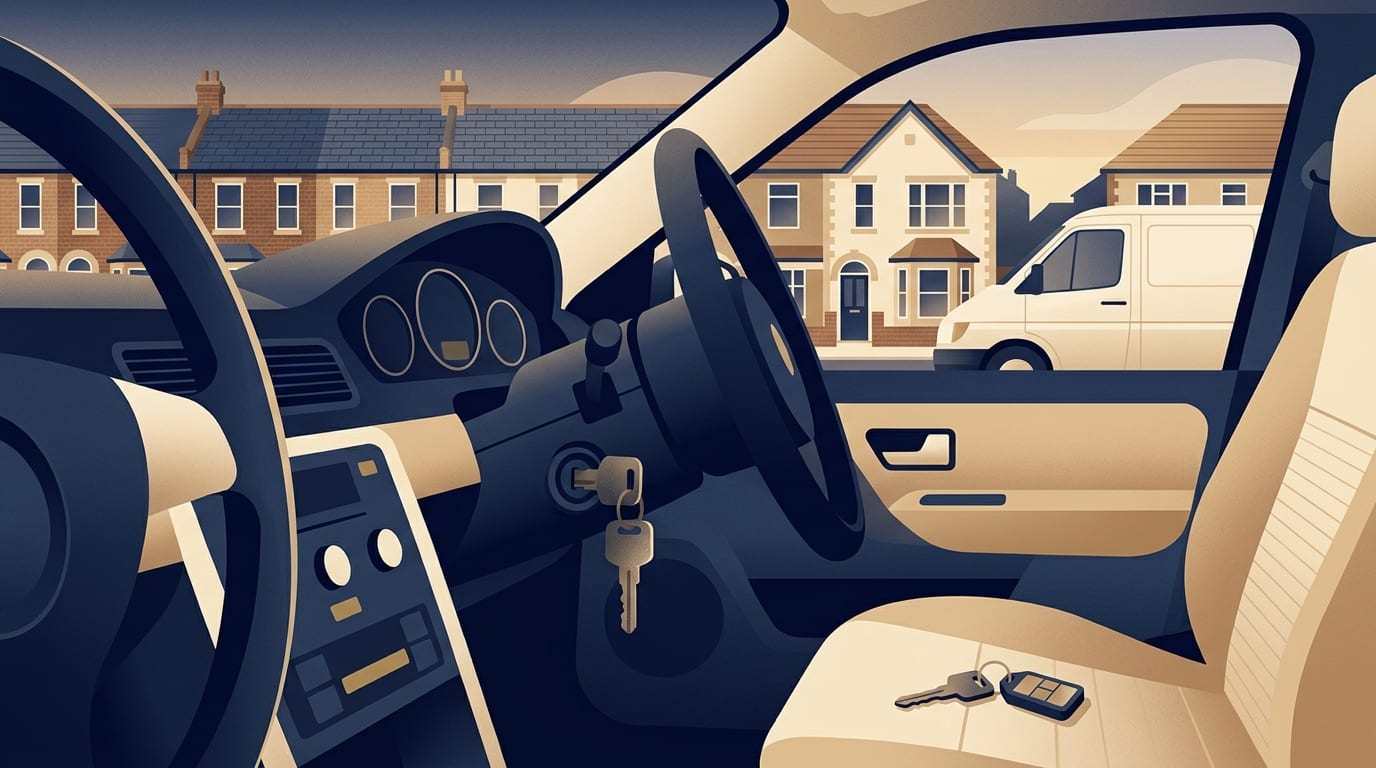
If you are sitting in the driver's seat and your ignition key will not turn, the RAC and the AA both point first to a jammed steering lock rather than a broken ignition barrel. They advise turning the steering wheel slightly from side to side while carefully turning the key. If this does not work, you may have a worn key or a mechanical fault inside the lock that requires an experienced auto locksmith.
Key will not turn and the steering lock
The steering lock is a mechanical security feature designed to stop a vehicle being driven away without the correct key. It engages when the key is removed from the ignition. Sometimes this mechanism becomes jammed under tension, making it impossible to turn the key when you put it back in.
This tension is often caused by the way the car was parked. The RAC notes that a steering lock jam is often caused by a front tyre on one side of the vehicle resting hard against a kerb. The AA adds that parking with the steering wheel on full lock can create the same problem.
What the RAC and AA say to try
Both the RAC and the AA provide the same practical steps to release a jammed steering lock. You need to relieve the tension on the steering column so the internal mechanism can move freely again.
You should turn the steering wheel slightly from side to side while carefully turning the key back and forth at the same time. Try to find the free-play area by rocking the steering, and see if the key will turn at this point. Keep your movements smooth and steady until the lock frees off.
You must not force the key. The AA warns that if you try to force the key to turn, it may break off inside the ignition. Stop immediately if the lock does not free. Do not use force, heavy tools or lubricating sprays to try and force the mechanism open.
A worn or bent car key
If the steering wheel moves freely but the key still refuses to turn, the key itself may be at fault. The Master Locksmiths Association (MLA) lists a damaged or worn key as a common reason for ignition problems. Car keys suffer daily wear from being kept in pockets, dropped on pavements and pushed into locks.
A key that is physically bent will not sit correctly inside the ignition barrel. A key that has worn smooth over years of use will no longer have the sharp, defined cuts needed to move the internal lock mechanisms into the correct alignment. If you have a spare key, try using it to see if the problem is isolated to your main key.
Damaged wafers inside the ignition barrel
The ignition barrel is the lock the key goes into on your dashboard or steering column. Inside this barrel is a series of small plates called wafers. When you insert a key in good condition, the cuts on the key blade push these wafers into a precise line, which allows the barrel to turn.
The MLA explains that the ignition is made of wafers that can bend and break over time. When a wafer is damaged, it can block the barrel from turning. If the wafers have failed, or if there is a complete steering wheel lock failure, the ignition barrel will need professional repair.
When a key is stuck or snapped in the ignition
Sometimes a key will turn part of the way and then become completely stuck, refusing to turn further or come back out. In worse cases, the pressure of trying to turn a stiff lock causes the plastic head of the key to snap off, leaving the metal blade trapped inside the dashboard.
An auto locksmith can help remove a car key that is stuck in the ignition. The MLA notes that while it looks like a key problem, sometimes the root cause is with the steering lock mechanism and not the actual car key. An auto locksmith can help with this.
When the immobiliser or key fob is the problem
Modern car keys contain a transponder chip that communicates with the vehicle immobiliser. If the key will physically turn in the ignition but the engine will not start, the security system may be failing to recognise the key. The RAC advises that you carry out a few basic checks before calling for help.
- Check the key fob battery to see if it needs replacing.
- Test the central locking to see if the remote buttons still open the doors.
- Try using the spare key to start the engine.
- Check the vehicle handbook.
If neither key is recognised by the car, the RAC states that the immobiliser or key may need further investigation by the dealer or a qualified specialist. You can read more about what to do if your car key fob not working is the main issue.
Auto locksmiths and how they differ from property locksmiths
When you search for help, you will see many businesses advertising as locksmiths. Auto locksmiths are a separate specialism covering vehicle entry, key cutting, transponder and remote programming. They are trained in non-destructive entry, which means picking or bypassing a lock rather than drilling it.
Many locksmiths work mainly on domestic doors, so check that the person you call is an auto locksmith. A property locksmith deals with a euro cylinder, which is the barrel on uPVC and composite doors. They replace a multipoint locking mechanism, which is the strip of hooks and bolts worked by lifting the handle, and the gearbox, which is the central part of that mechanism. They are trained to protect homes against lock snapping and deal with boarding up after a break-in.
On traditional timber doors, a property locksmith will fit a mortice deadlock and sashlock inside the wood, or a night latch or rim lock on the surface, which is often called a Yale lock. They can change a rim cylinder and set up locks to be keyed alike so that one single key opens several doors. Because vehicle work is a separate specialism, make sure the person you call is a trained auto locksmith.
Lock standards and home insurance
If your car keys are lost or stolen, your house keys may be on the same keyring. If you need to upgrade your home security at the same time, it helps to understand UK lock standards. BS3621 is the British Standard for mortice and rim locks on timber doors, shown by a Kitemark on the lock faceplate.
For euro cylinders, the snap-resistant standards are TS007 three star, or a one-star cylinder fitted with two-star handles. An alternative high security standard is Sold Secure SS312 Diamond. Insurers often ask what locks are fitted to your external doors, so you should check your own policy wording rather than guessing what your provider expects.
Regulation, consumer rights and avoiding scams
There is no government licensing of locksmiths in the UK. Anyone can legally trade as one, which is why vetting the person you hire matters. The Master Locksmiths Association (MLA) is the main trade association. This is a voluntary approval scheme, not a legal requirement. MLA approved companies are vetted, have criminal record (DBS) checks, employ locksmiths who have passed the MLA exam and are inspected regularly.
Under the Consumer Rights Act 2015, a service must be carried out with reasonable care and skill, at a reasonable price if none was agreed in advance, and within a reasonable time. You have a right to have poor work put right or your money back. Under the Consumer Contracts Regulations 2013, there is normally a 14-day cancellation period for work arranged at home or by phone. This does not apply where you specifically asked for a visit for urgent repairs, although any extra work sold to you during that visit is not covered by the exception.
If you are locked out of a rented home because your keys are trapped in your car, tenants should check their tenancy agreement and get the landlord's agreement before changing any house locks. A landlord who changes the locks to keep a tenant out without a court order commits illegal eviction, a criminal offence. You should contact Citizens Advice or Shelter for guidance on your specific housing situation.
How to spot bad advice and poor practice
Because the industry is unregulated, you must watch out for rogue operators. A common problem is national call centres advertising as a local locksmith and passing the job to whoever is nearest. They often quote a very low price on the phone that multiplies as soon as the person arrives on your doorstep.
Other signs of a poor operator include drilling a lock that could have been opened without damage, or refusing to give a total price before starting work. On house doors, bad practice includes replacing a whole multipoint mechanism when only the cylinder or gearbox had failed, or fitting cheap cylinders at premium prices. You should also be cautious of anyone demanding cash only, refusing to provide a written invoice, showing no ID, driving an unmarked vehicle, and having no verifiable company name or address.
What an auto locksmith can do to fix it
An experienced auto locksmith will diagnose the cause of the ignition failure before deciding on a repair. They can also help if a key is stuck or snapped in the ignition.
If the internal wafers are bent or broken, an auto locksmith can often repair the barrel for you, sometimes without having to remove the barrel from the dashboard. If the damage is severe, the MLA says the barrel may need to be removed and repaired. You can read more about this process on the MLA car lock repairs page.
Typical costs for removal and repair
Jobs are usually priced as labour plus parts, either by the hour or as a fixed price per job. Because there is no government body for locksmiths, there is no set price structure a locksmith has to follow. The MLA recommends getting at least three quotes before agreeing to any work.
The table below shows MLA estimates for removing a stuck key and fitting a new ignition.
|
Job |
Typical price |
|---|---|
|
Remove stuck or snapped key |
From £90 |
|
New ignition, parts only |
From £45 |
|
Fitting a new ignition, labour |
From £70 |
These are MLA estimates and prices vary by vehicle and time of day. Some models need a new ignition because it has broken down, and the job can take up to an hour.
The total cost is driven by the time of day, as evenings, nights, weekends and bank holidays cost more. Location also matters, with London and the South East costing more than other areas. The price of parts depends on the model of the vehicle.
The MLA notes that the cost may increase on certain makes, where removal must be carried out by an experienced auto locksmith. If the work is not done correctly, the bill could end up over £300. You can check these estimates on the MLA key stuck in ignition page.
Choosing between a locksmith, dealer or breakdown service
If your car is parked safely on your own driveway, the job can usually wait until the daytime rate applies. If you are stranded in a dark car park late at night, the repair is urgent and you may have to pay an out-of-hours charge.
If you have breakdown cover, calling the RAC or AA is a sensible first step, especially if you suspect a jammed steering lock. If the barrel needs physical repair or replacement parts, you will need to choose between an auto locksmith or main dealer. Some auto locksmiths will come to your vehicle, so ask whether they do. A main dealer may need the car brought to their workshop.
Common questions
Can I use tools or sprays to free the ignition?
You should not use pliers, grips or any heavy tools to force the key to turn. The AA clearly states that you should not try to force the key or it may break. Do not use sprays either.
Will my existing keys still work after a repair?
Ask the locksmith before work starts whether your existing keys will still work. That depends on whether the barrel is repaired or replaced.
Why does my car not recognise the key?
If the key turns smoothly but the engine will not start, the immobiliser may not be reading the transponder chip. The RAC advises checking the key fob battery, testing the central locking, trying your spare key and reading the handbook. If neither key is recognised, a specialist will need to investigate.
What if the key still will not turn?
If you have tried the RAC and AA advice and the key still will not turn, stop and do not force it. The MLA lists a damaged or worn key, damaged wafers and a steering lock fault as common causes, so call an experienced auto locksmith.
What to do next
Before you agree to any call-out, you should vet the company on the phone. Check they have a real local address, look for customer reviews built up over time, and verify any MLA approval claim directly on the MLA's own website. Ask for ID on arrival and insist on a written invoice when the job is done.
- Ask for a total price, including parts, VAT and any out-of-hours charge, before work starts.
- Ask whether a new barrel is likely to be needed or if a repair is possible.
- Ask whether your existing keys will still work in the locks and with the immobiliser.
- Ask if they operate a mobile service and will come directly to your vehicle.
- Ask how entry will be gained if you are locked out of the car.
If your ignition key will not turn and the steering wheel trick has not worked, your next step is to find a locksmith near you who specialises in auto security.
Find a top rated locksmith near you
1,787 locksmiths across the UK, each ranked on their Google rating and the number of reviews behind it. Start with your county: